I'm a software engineer with 8+ years of experience building and scaling high-traffic web and search systems for multi-million-user platforms. I specialize in search relevance, performance engineering, observability, and experimentation, with a strong track record of delivering measurable improvements to reliability, latency, and user experience.
I design and build full-stack applications across SSR and CSR, with deep expertise in React, TypeScript, and modern Next.js architectures. My work consistently focuses on identifying and reducing page load times, improving Web Vitals, and ensuring fast, stable user experiences at scale. I've led cross-team efforts to eliminate layout shift, optimize payloads and data flows, and improve client responsiveness across critical product surfaces.
A significant part of my work centers on search systems and experimentation. I've owned end-to-end A/B experimentation for search APIs, telemetry, and ads platforms—ensuring statistical validity, clean data contracts, and experiment readiness across teams. I've led the integration of AI-powered search solutions with external vendors, including API design, relevance evaluation, and A/B comparisons against in-house systems, resulting in improved search relevance and content discovery.
Beyond feature delivery, I focus heavily on reliability and engineering excellence. I've built and maintained observability tooling and dashboards in Datadog, led error triage initiatives that eliminated recurring production issues, and driven org-wide standards around error handling, instrumentation, and performance budgets. I enjoy leading complex initiatives, mentoring engineers through design reviews and pairing, and leaving systems simpler, faster, and easier to evolve.
I'm motivated by pragmatic engineering, clear ownership, and solving problems that sit at the intersection of product impact, system design, and scale.
Here are a few of my technologies of interest, so far:
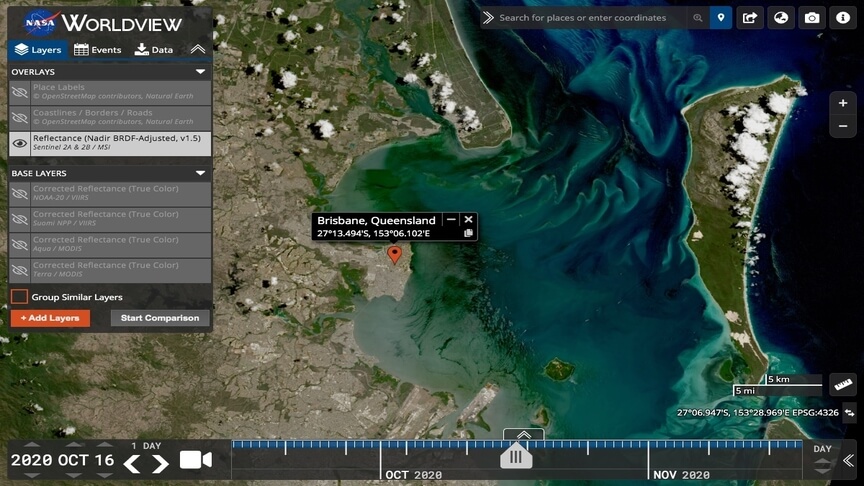
I had the pleasure to develop on the NASA Worldview application for a few years. NASA Worldview provides a satellite's perspective of the planet as it looks today and as it has in the past. Worldview provides the capability to interactively browse 800+ global, full-resolution satellite imagery layers accessing multiple APIs, and download underlying science data. Many of the imagery layers are updated within three hours of observation, essentially showing the Earth as it looks "right now". This supports time-critical areas such as wildfire management, air quality measurements, and flood monitoring.
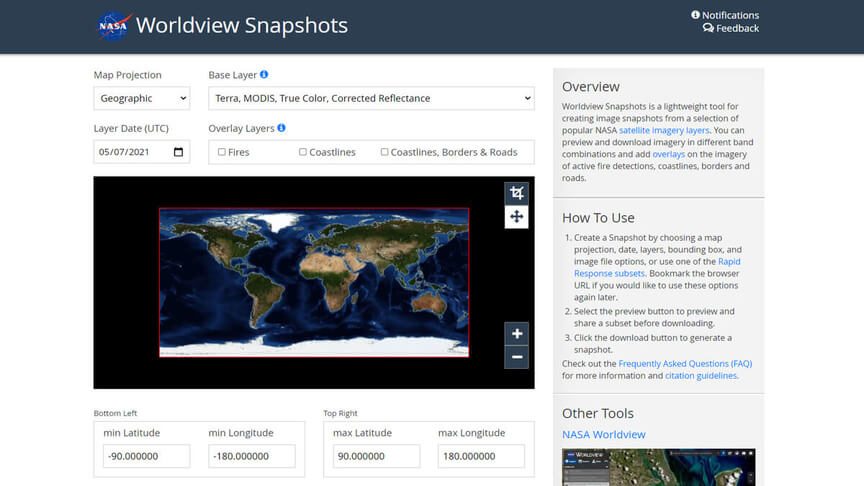
View Live View RepoWorldview Snapshots is a lightweight, lower bandwidth tool for creating multiple format image snapshots from a selection of popular NASA satellite the Global Imagery Browse Services (GIBS) API imagery layers. You can preview and download imagery in different band combinations and add overlays on the imagery of active fire detections, coastlines, borders and roads.
View LiveThis React application is a mobile-first design episode guide for the show Mystery Science Theater 3000. It allows you to toggle through seasons, episodes, and link to IMDB and YouTube. A search feature provides episodes by title query. Client-side requests are handled with Axios client.
View RepoThis application was created to help narrow down movie choices by searching for movies, retrieving detailed information, providing IMDB links, and saving movies to watch for later. It uses routed API's to fetch data, add to a temporary movie pool(anonymously or logged in), and store client associated data. This RESTful application was built using MongoDB mLab for data storage, Express(with EJS), and NodeJs.
View RepoThis application calculates beats per minute (BPM) to assist in timing delays and reverbs for users interested in digital music production and analog instruments. Main design characteristics are minimalist UI and responsiveness for mobile.
View Live View RepoProjects include a vanilla JS Calculator, React Pomodoro Clock, jQuery Tic-Tac-Toe, and various API/AJAX apps. These Code Pen projects were created as part of the Front End Development Certificate which I enjoyed working through at freeCodeCamp. This course was valuable in learning the fundamentals of numerous front end technologies.
View Codepen Portfolio